Can't Afford Adobe Anymore? Build It Yourself. Someone Already Started

Tsolo Moahloli
Founder, Uhuru AI
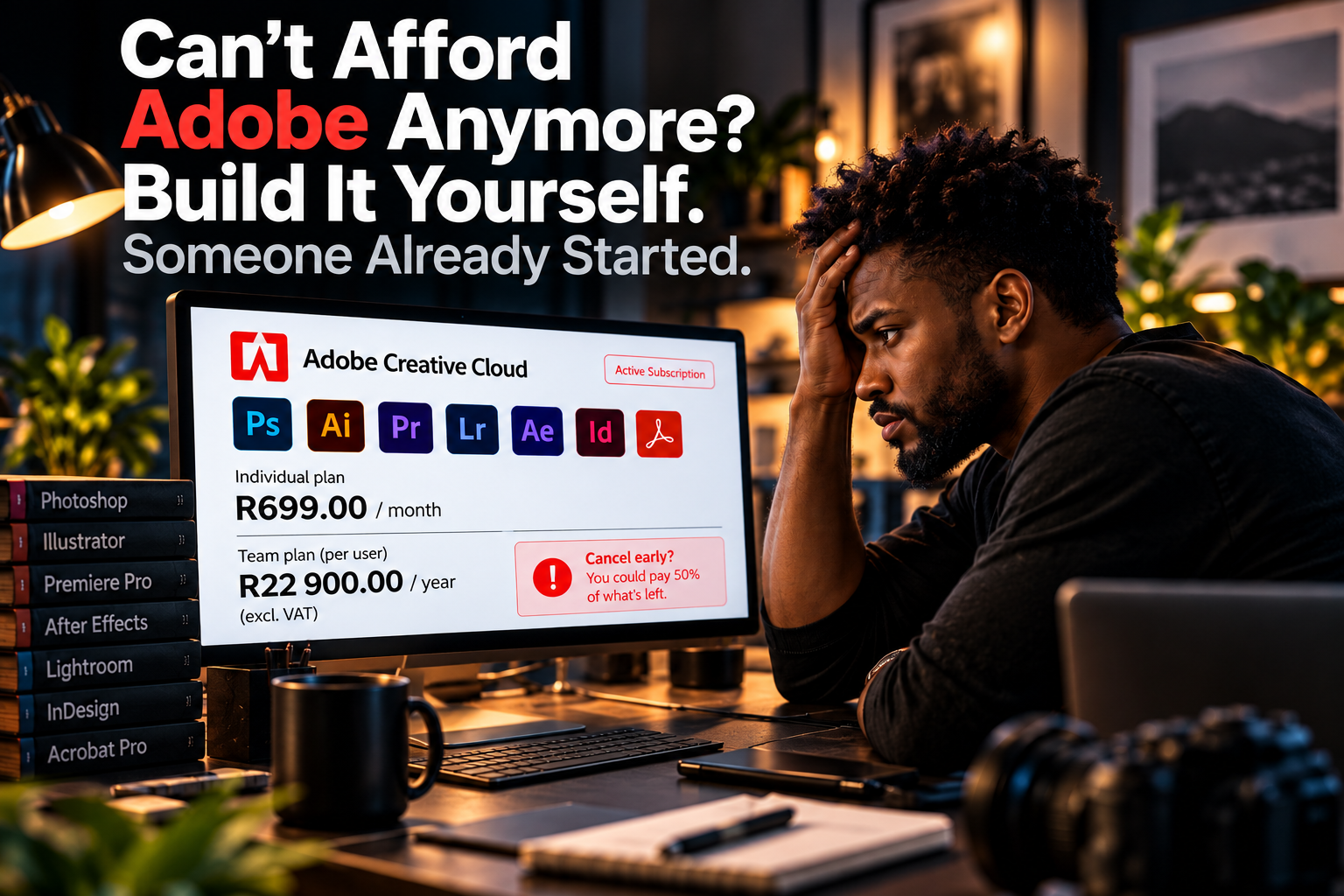
Open your bank statement and find the Adobe line.
In South Africa, Creative Cloud sits around R699 per month for one person. That is R8 400 a year. If you run a small studio on the team plan, local resellers list it at roughly R22 900 excluding VAT per user per year, which lands near R26 300 with VAT on. Five people and you are looking at a six figure annual line item.
You do not own any of it. Stop paying and it all switches off. Try to leave mid-contract and Adobe can charge you 50 percent of whatever is left on your annual plan. Cancel the Pro plan six months in and the penalty lands around $165, just for the privilege of stopping.
That last bit got expensive for Adobe. In March 2026 the company settled with US regulators for $150 million, made up of $75 million in civil penalties and $75 million in free services, over claims that it buried those cancellation costs and made leaving deliberately hard. The settlement forced Adobe to disclose the fees upfront. It did not get rid of them.
Meanwhile the price keeps going up. Adobe raised All Apps pricing by about 9 percent in 2023 and about 6 percent again in 2025.
And you are paying all of it in dollars while earning in rands. Every time the exchange rate moves against you, your software bill goes up and nobody sent you an email about it.
Here is the thing nobody tells small business owners: you have a third option. Not "pay it" and not "pirate it." Build it.
Someone already got fed up and started
In October 2026 a developer called Brandon Thomas released free, open source versions of all seven Adobe apps. PhotoCraft for Photoshop. VectorCraft for Illustrator. FilmCraft for Premiere. LightCraft for Lightroom. EffectCraft for After Effects. DesignCraft for InDesign. PrintCraft for Acrobat Pro. He called the project ArtCraft.
He built them with AI. Specifically Claude Opus 5.5, writing in Rust, which is a serious low level programming language and not a shortcut. They run on Mac, Windows and Linux. They are licensed under MIT and Apache, which means anybody can download them, change them, or use them commercially without paying a cent.
His reason was not ideology. He got hit by Adobe's cancellation fee one too many times.
Thomas is not a kid messing about. He describes himself as a fifteen year industry veteran with about a decade of Rust experience. And he got all seven apps to a working first version fast enough that it made global news.
Let me be straight with you: it is not good enough yet
I am not going to sell you a fantasy.
ArtCraft is an early alpha. People who downloaded it found basic things broken. One widely shared report described the Free Transform tool in PhotoCraft refusing to exit properly, randomly undoing work, then quietly starting to behave again for no clear reason. Multiple reviewers landed on the same verdict: it looks like Adobe, it does not yet work like Adobe.
Thomas himself pulled his claims back. On Reddit he said full feature parity in a month. On Hacker News he changed that to 99 percent parity taking "months and not years." Those are very different promises.
So if you are a working designer billing clients tomorrow morning, keep paying Adobe. This is not your escape hatch today.
But that is exactly why it matters
Here is what most people got wrong about this story.
An early alpha that looks like Photoshop is not a failure. It is a starting line.
The code is open. MIT and Apache licences. That means it is not one man's project anymore, it is everybody's. Anyone can fork it, fix the Free Transform tool, add the missing features, and ship it back. Software gets good because people keep working on it, not because it arrives perfect.
Think about what already happened here. One person, working alone, got seven complex desktop applications to a working first version in a matter of weeks. In 2021 that was a funded startup with a team and eighteen months of runway. The hard part, the part that used to be impossible for an individual, is already done. What is left is polish, and polish is just time and attention.
Give that project a year and a handful of contributors and there is a real chance it becomes genuinely usable. Give it three and it could be the thing you actually switch to. Blender went through exactly this. It was a joke for years. Now studios use it on films.
The lesson is not "ArtCraft will replace Adobe." The lesson is: building your own software just became something an ordinary skilled person can do. And that applies to you.
And yes, it is legal
This is the question everyone asks, and it is worth answering properly before you consider building anything that resembles a product you currently pay for.
Short version: copying what software does is generally legal. Copying how it does it is not.
Copyright protects creative expression. It does not protect function, ideas, or methods. That line was drawn in Baker v. Selden in 1879, an American case about bookkeeping forms, and it has held ever since. You cannot copyright the act of blurring a photograph. You can copyright the specific code you wrote to do it.
Two more cases sharpen it.
In Lotus Development Corp. v. Borland International the First Circuit ruled in 1995 that the menu command structure in Lotus 1-2-3, the actual arrangement and labelling of its menus, was an uncopyrightable "method of operation." The court's reasoning was practical. If menu layouts were protected, users would have to learn a completely different way to do the same basic task in every single program they open. It went to the Supreme Court in 1996, but a recusal left the bench split evenly, so the lower ruling stood without becoming national precedent.
Then in Google LLC v. Oracle America in 2021, the US Supreme Court held that Google rebuilding the Java APIs was fair use. That put reimplementing an interface on well defended ground.
This is why Thomas calls ArtCraft a "clean room replacement." Clean room means you study what the original does from the outside, write down a specification, then build from that spec without ever touching the original source code. Adobe's code is closed, so he could not have copied it even if he wanted to. He rebuilt behaviour he could observe as a user.
On copyright, that is solid.
Where the risk actually sits, because it would be dishonest to stop there:
Trade dress. Copyright is not the only protection. Trade dress covers the distinctive look of a product, including interface design. Copying a competitor's screens closely creates exposure no matter how cleanly you wrote the code. Nobody has tested this against ArtCraft yet.
Clean room procedure does nothing about patents, because patents protect the idea itself. For a commercial product, patents are often the bigger threat than copyright.
AI training contamination. This one is new and genuinely unsettled. The whole clean room defence rests on never having seen the original code. But large AI models are trained on vast amounts of public code. If a model has absorbed source code somewhere in its weights, the wall is not as clean as it looks on paper. A Munich court ruled in GEMA v. OpenAI in late 2025 that infringement can happen when a model reproduces copyrighted content in its output, even where the training data was obtained lawfully. Nobody has applied that reasoning to a commercial software clone yet. Someone will.
One more thing worth knowing if you plan to build and sell. In March 2026 the US Supreme Court declined to review Thaler v. Perlmutter, which leaves standing the position that work generated by AI without meaningful human creative input cannot be copyrighted. You could end up unable to protect the thing you just built.
And the obvious caveat: these are all American cases. South African copyright law draws the same broad line between protected expression and unprotected function, but the local case law is thinner and I am not citing an SA judgment here. If you are going to build something that resembles a competitor's product, talk to a South African IP attorney before you ship, not after.
Start smaller than Photoshop
Now the practical part.
You are probably not going to rebuild Photoshop, and you should not try. Not because it is illegal. Because it is thirty years of accumulated work and your business does not need you to re-fight that battle.
Look at the rest of your subscriptions instead. The ones that are not Photoshop:
The booking system charging you per seat. The client portal you use at ten percent of capacity. The reporting dashboard that exists purely to turn one spreadsheet into one chart. The internal approvals tool nobody actually chose. The CRM add-on that got bundled in. The scheduler. The invoice reminder thing.
Those are not thirty years of work. Those are two weekends. And unlike Adobe, nobody is maintaining a thirty year feature set you need to match. You need the five features you actually use.
That is where the money is. Not in heroically cloning the biggest software company in the world, but in quietly killing four small monthly payments and owning the replacements.
What you actually need to pull this off
The phrase doing all the heavy lifting in every ArtCraft headline is "with the right know-how." Here is what that cashes out to in practice.
You still need judgement. Thomas has fifteen years of experience and a decade in Rust. AI did not hand him that. It gave him speed on top of judgement he already had. AI will happily write you code that runs and is quietly wrong, and someone has to catch that. If you do not have that person, hire or partner with them. Do not skip this step.
Scope ruthlessly. The internal tools that succeed replace one specific annoying workflow. The ones that fail try to replace a whole platform. Pick the smallest thing that still saves you real money or real hours.
Own your data. The underrated win here is not the saved subscription. It is that your client information sits in your database, in your country, under your control, instead of on someone's server subject to a terms of service update you will never read.
Budget for maintenance. Software is not a once off purchase, it is a pet. If nobody owns it after launch, it rots. This is what actually kills internal tools, and it is the open question hanging over ArtCraft too.
Know when to keep paying. If a tool is cheap, genuinely excellent, and core to someone else's whole business, keep the subscription. Rebuild the overpriced, the underused, and the badly fitting. The test is three questions: what does it cost me per year in rands, how much of it do I actually use, and how much does it hurt if it disappears tomorrow?
The honest warning
I would be doing you a disservice if I only showed you the upside, so here is the research that cuts the other way.
A randomised controlled trial by METR took 16 experienced open source developers and gave them 246 real tasks on large, mature codebases. With AI assistance they were 19 percent slower. Worse, they came away convinced they had been 20 percent faster. That is a 39 point gap between how it felt and what actually happened, and it is the most important number in this whole article. The slowdown came from the overhead of reviewing and fixing generated code. METR now flags the result as historical since it used early 2025 tooling, but the perception gap has not aged at all.
Google's 2025 DORA report found the same shadow from another angle: AI increases delivery instability. Teams ship faster and break more, unless the engineering discipline is already there.
But look at the other half. A controlled GitHub study found developers 55 percent faster building something new in unfamiliar territory: 1 hour 11 minutes against 2 hours 41 minutes. Pull request cycle time in deployment data dropped from 9.6 days to 2.4 days. Accenture reported an 84 percent increase in successful builds after rolling out AI assisted pull requests internally. DORA found 90 percent adoption among developers and over 80 percent reporting a productivity improvement.
Both sets of findings are real. Put them together and the pattern is clear:
AI slows you down when you are deep in a big existing system you already know well. AI speeds you up when you are building something small and new in territory you do not know.
Which is exactly the shape of a custom internal business tool. Small. New. Built from nothing. That is the best case for this technology, not the worst. The opportunity is real, it is just not where the headlines are pointing.
What to do this week
Forget the clones for a second. Do this instead, it takes ten minutes and needs no technical skill at all.
Open your bank statement and your card statement.
Write down every single software subscription you pay for.
Next to each one, write the annual cost in rands. Multiply the monthly by twelve. Convert the dollar ones at today's rate.
Mark every tool you use less than a quarter of.
Add up the marked ones.
That number is your budget for building something you own.
Most people are genuinely shocked by it. Not because any single line is big, but because nobody ever adds them up.
Software is not over, whatever the headlines said. What changed is the floor. Building software used to need capital and a team. Now it needs skill and good tooling. That does not kill software companies. It kills software companies whose only real protection was that building the alternative was too expensive.
If something on your list falls into that category, you have options you did not have in 2024.
Sources
ArtCraft: Free Open Source Adobe Alternatives Built With AI, tbreak
Everything We Know About the Free Adobe Clones Built With AI, VICE, 9 October 2026
Artcraft Releases Free AI-Built Clones Of Seven Adobe Apps, The Open Letter, 8 October 2026
"Software Is Over": Developer Uses AI to Build Free Adobe Alternatives, Gadget Review / Yahoo Tech
ArtCraft is now a seven-app open-source Creative Cloud alternative, Softonic
ArtCraft Launches an Open-Source, AI-Powered Alternative to Adobe's Creative Cloud, The Dieline
AI Clean Room Engineering: Can You Legally Rebuild What You Can See, Hexaware
Lotus Development Corp. v. Borland International, Inc., 49 F.3d 807 (1st Cir. 1995), BitLaw
Google LLC v. Oracle America, Inc., 141 S. Ct. 1163 (2021), US Copyright Office fair use index
Adobe Creative Cloud Pricing 2026: Plans, Hidden Costs and Cheaper Alternatives, ToolRadar
Adobe Creative Cloud Price by Country 2026, SubscriptionsCompare
AI Coding Productivity, What 2026 Studies Show: METR, GitHub and DORA, ValueAdd
Adobe Creative Cloud for teams All Apps, 1 user, SA reseller listing, Nivo
Tsolo Moahloli
Founder, Uhuru AI
Tsolo Moahloli is the founder of Uhuru AI, a Pretoria-based AI automation firm helping South African SMBs save 20+ hours weekly through practical automation. He specialises in workflow automation, AI assistants, and sales AI systems built for the South African market.
Learn more about Tsolo