Humanoids Are Coming for the Jobs AI Can't Touch Yet

Tsolo Moahloli
Founder, Uhuru AI
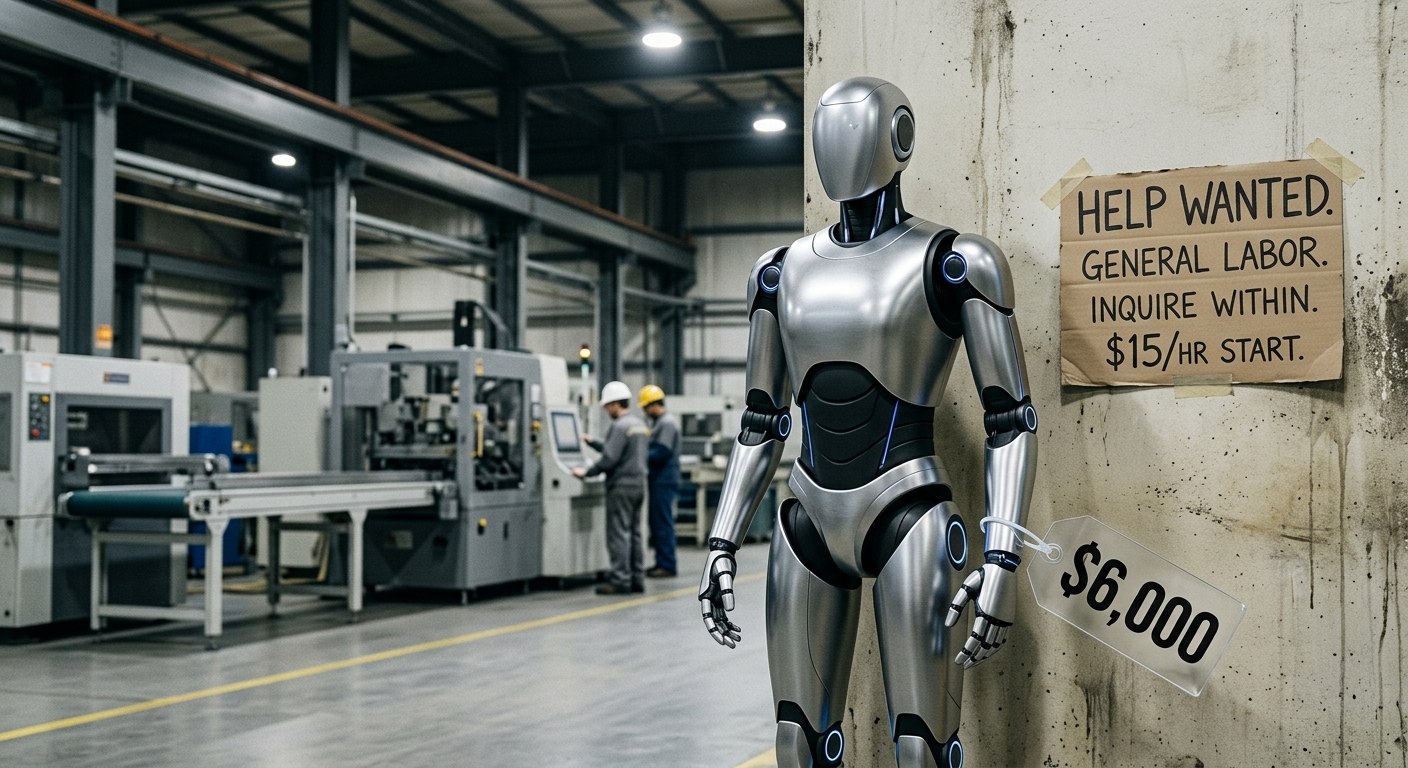
For the past three years, the conversation about AI and work has focused almost entirely on white-collar jobs. Accountants, lawyers, copywriters, coders, analysts. The knowledge workers. Th The people sitting in front of computers.
And that conversation was warranted. AI has genuinely disrupted knowledge work at scale. Tasks that took teams of people now take one person with the right tools. Entry-level white-collar roles are under serious pressure.
But there is a second wave building. One that most people have not absorbed. And for Africa, it is potentially more consequential than anything AI has done to office work.
The robots are coming for the physical jobs.
What Is Actually Happening Right Now
This is not a future prediction. This is a status report.
As of early 2026, Tesla has over 1,000 humanoid robots (Optimus Gen 3) working on the floor of its own factories, handling parts processing, kitting, and material handling. Tesla broke ground on a dedicated humanoid manufacturing facility in November 2025 targeting production capacity of 10 million units per year by 2027 [1].
A company called Figure AI deployed its Figure 02 robot at BMW's Plant Spartanburg in South Carolina. Over 10 months, the robot helped build over 30,000 BMW X3 vehicles, retrieving and positioning sheet metal parts for welding, five days a week, 10 hours per shift. Figure 02 achieved a 400% improvement in speed and a 7x improvement in task success rate over a single deployment cycle [2]. BMW is now expanding to Plant Leipzig in Germany, making it the first humanoid deployment in European car production [3].
Amazon has been running Agility Robotics' Digit humanoid in its fulfillment centers. After 18 months of testing, Digit achieves a 98% task success rate and has moved over 100,000 warehouse totes [4]. The economics are direct: Digit operates at an estimated $10-12 per hour. A human warehouse worker costs around $30 per hour.
Boston Dynamics' Atlas robot was unveiled at CES in January 2026, with all 2026 units already committed. They are going to Hyundai's robotics plant near Savannah, Georgia, and to Google DeepMind. Atlas stands at 5'9", weighs 200 pounds, has 56 degrees of freedom, can lift up to 110 pounds, and can swap its own battery in under 3 minutes, enabling 24/7 operation [5].
And then there is Unitree. A Chinese manufacturer building the cheapest full humanoid on the market. The Unitree G1, available today, costs between $16,000 and $17,990. It can walk, handle delicate tasks, open bottles, and weld. Unitree shipped over 5,500 humanoid robots in 2025 alone, roughly one-third of the entire global humanoid market [6].
This is not a research project. This is a commercial rollout.
The Cost Math Is Brutal
Goldman Sachs confirmed that humanoid robot manufacturing costs fell 40% in a single year in 2025. The firm projects the global humanoid market will reach $38 billion by 2035, a sixfold upward revision from their previous estimate, driven by faster-than-expected AI integration with physical systems [7].
At current trajectory, entry-level humanoids are expected to hit $10,000-$15,000 by 2030. At those prices, a robot operating at the equivalent of $10-12 per hour pays for itself in under 18 months in most manufacturing environments.
Bank of America projects that by 2060, there will be more humanoid robots on earth than cars: three billion units, with 62% in homes [8].
The pace of cost reduction follows the same pattern as solar panels and smartphones. Once costs enter that curve, adoption stops being a question of whether and becomes only a question of when.
Why This Is Different From Every Previous Automation Wave
Every generation has faced technological displacement and survived. The spinning jenny displaced hand weavers. Assembly lines displaced artisan manufacturers. Computers displaced typists and bookkeepers. Each time, new jobs emerged. The story always had a second chapter.
There are three things that make this wave structurally different.
The first is form factor. Previous industrial robots were fixed, single-purpose machines that required environments to be rebuilt around them. Humanoid robots are designed to work in spaces built for humans: factories, warehouses, farms, kitchens. They do not require infrastructure transformation. They plug in.
The second is general purpose. A welding robot welds. A humanoid can weld, then carry the part to the next station, sort it, check it against a specification, and restock the component bin. The same unit. This is not a replacement for a single role. This is a replacement for a workflow.
The third is the learning rate. Figure 02 improved 400% in speed and 7x in task success within one deployment cycle [2]. At that rate of improvement, the capability gap between what robots can do and what humans can do closes in years, not decades.
Goldman Sachs described humanoid robots as "the AI accelerant" in their 2025 research [9]. The large language model is the brain. The humanoid body is the hands. Separately, neither was sufficient for general-purpose work. Together, they approach something close to a general-purpose labor substitute.
The World Economic Forum, in a June 2025 report, confirmed that humanoid robots are "no longer a research curiosity" but "an active industrial tool" [10].
What This Means for Africa
Here is where the conversation becomes urgent.
There are 240 million people employed in Africa's agricultural sector, representing 48% of total employment across the continent [11]. Countries like Burundi (86%), Madagascar (74%), and Burkina Faso (73%) have agriculture as almost their entire economic base. Sub-Saharan Africa needs to create over 20 million new jobs every year until 2050 just to keep pace with its growing working-age population [12].
The traditional development model, the path every currently wealthy country followed, goes like this: agriculture gives way to low-wage manufacturing, manufacturing creates a middle class, that middle class funds services and education, and over time the country industrializes. South Korea, Taiwan, China, Malaysia, and the Asian tigers all climbed this ladder. Low wages attracted foreign manufacturing investment. Factories trained workers. Cities grew. Infrastructure followed.
Africa was supposed to be next.
Humanoid robots are threatening to pull the ladder up before Africa reaches the first rung.
The Brookings Institution states directly: "Labor-saving technologies in high-income economies are reducing the importance of low wages in determining production costs, which potentially narrows the path for African countries to industrialize through labor-intensive manufacturing." [13]
When a German, American, or Chinese factory can produce goods domestically using humanoid robots at $10-12 per hour equivalent, with no logistics delays, no currency risk, and superior quality control, the cost advantage of $3-per-hour African labor disappears. The factory does not move to Ethiopia. It stays in Stuttgart and hires a robot fleet.
Research published in ScienceDirect in 2025 confirms this effect is already measurable. Industrial robotics adoption in developed countries correlates directly with deindustrialization in developing countries. The spillover is real and quantifiable [14].
In South Africa specifically, approximately 1.675 million people work in manufacturing as of December 2024 [15]. Accenture estimates that 6 million South Africans are already at risk of losing their jobs to automation broadly. South Africa already has the highest sustained unemployment rate of any major economy, sitting above 31%. The automotive sector (BMW, Mercedes, Toyota, and Volkswagen all operate South African plants) is among the first industries deploying humanoids globally. Those same companies are running humanoid pilots in Germany, South Carolina, and Georgia right now.
The deeper risk is not just displacement. It is what economists call premature deindustrialization: manufacturing's share of employment shrinks before a country has fully developed, locking it in a growth trap. Africa faces the prospect of skipping the manufacturing rung of the development ladder entirely, not by choice, but because the rung is being automated away.
The Question Africa Has to Answer
This is not cause for paralysis. It is cause for urgency.
The continent's response to this challenge will define economic outcomes for a generation. There are real paths forward: investing in AI and robotics capability locally rather than only consuming technology built elsewhere, finding the sectors where human judgment, relationships, and local knowledge remain advantages, and building the infrastructure for African businesses to participate in AI-enabled economic activity rather than only being displaced by it.
The businesses and workers who understand what is coming, and who are building skills, systems, and strategies to operate in an AI-plus-humanoid economy, will have options. The ones operating on the assumption that the job market of 2020 will resemble the job market of 2030 will not.
At Uhuru AI, we are working with African businesses on practical AI adoption now, before the capability gap widens further. The window to build AI fluency and AI-integrated operations is open. The question is whether African businesses use it.
Citations
[1] Vision Times. Elon Musk Predicts Robot Era Will Arrive in 2026, Warns of a Painful 3-7 Year Transition. January 2026. https://www.visiontimes.com/2026/01/23/elon-musk-predicts-robot-era-will-arrive-in-2026-warns-of-a-painful-3-7-year-transition.html
[2] Figure AI. F.02 Contributed to Production of 30,000 Cars at BMW. 2026. https://www.figure.ai/news/production-at-bmw
[3] BMW Group. Humanoid Robots in European Production. 2026. https://www.press.bmwgroup.com/global/article/detail/T0455864EN
[4] Agility Robotics. Digit Moves Over 100,000 Totes. 2025. https://www.agilityrobotics.com/content/digit-moves-over-100k-totes
[5] Boston Dynamics. Atlas Humanoid Robot. 2026. https://bostondynamics.com/products/atlas/
[6] Unitree. G1 Specifications and Pricing. 2025. https://www.unitree.com/g1/
[7] Goldman Sachs. The Global Market for Robots Could Reach $38 Billion by 2035. 2025. https://www.goldmansachs.com/insights/articles/the-global-market-for-robots-could-reach-38-billion-by-2035
[8] Fortune. Bank of America Humanoid Robot Forecast: 3 Billion by 2060. March 2026. https://fortune.com/2026/03/13/bank-of-america-humanoid-robot-forecast-3-billion-2060/
[9] Goldman Sachs. Global Automation: Humanoid Robot the AI Accelerant. 2025. https://www.goldmansachs.com/insights/goldman-sachs-research/global-automation-humanoid-robot-the-ai-accelerant
[10] World Economic Forum. Humanoid Robots Offer Disruption and Promise. June 2025. https://www.weforum.org/stories/2025/06/humanoid-robots-offer-disruption-and-promise/
[11] Statista. Number of People Employed in Agricultural Sector in Africa. 2022. https://www.statista.com/statistics/1322329/number-of-people-employed-in-agricultural-sector-in-africa/
[12] ISS African Futures. Work and Jobs. 2025. https://futures.issafrica.org/thematic/13-work-jobs/
[13] Brookings Institution. Is Automation Undermining Africa's Industrialization Prospects? https://www.brookings.edu/articles/foresight-africa-viewpoint-is-automation-undermining-africas-industrialization-prospects/
[14] ScienceDirect. Industrial Robotics and Deindustrialization in Developing Countries. 2025. https://www.sciencedirect.com/science/article/abs/pii/S004016252500455X
[15] CEIC. South Africa Manufacturing Employment, December 2024. https://www.ceicdata.com/en/south-africa/employment-by-industry/employment-labour-force-survey-manufacturing
[16] Center for Global Development. Automation and AI: Implications for African Development Prospects. https://www.cgdev.org/publication/automation-and-ai-implications-african-development-prospects
Vision Times. Elon Musk Predicts Robot Era Will Arrive in 2026. https://www.visiontimes.com/2026/01/23/elon-musk-predicts-robot-era-will-arrive-in-2026-warns-of-a-painful-3-7-year-transition.html
Omdia. Global Humanoid Robot Shipments to Exceed 10,000 Units by 2027. https://omdia.tech.informa.com/pr/2024/jul/omdia-global-humanoid-robot-shipments-to-exceed-10000-units-by-2027-and-reach-38000-units-in-2030
Tsolo Moahloli
Founder, Uhuru AI
Tsolo Moahloli is the founder of Uhuru AI, a Pretoria-based AI automation firm helping South African SMBs save 20+ hours weekly through practical automation. He specialises in workflow automation, AI assistants, and sales AI systems built for the South African market.
Learn more about Tsolo