If AI Cannot Find You, You Do Not Exist: The Search Shift That African SMBs Cannot Afford to Ignore

Tsolo Moahloli
Founder, Uhuru AI
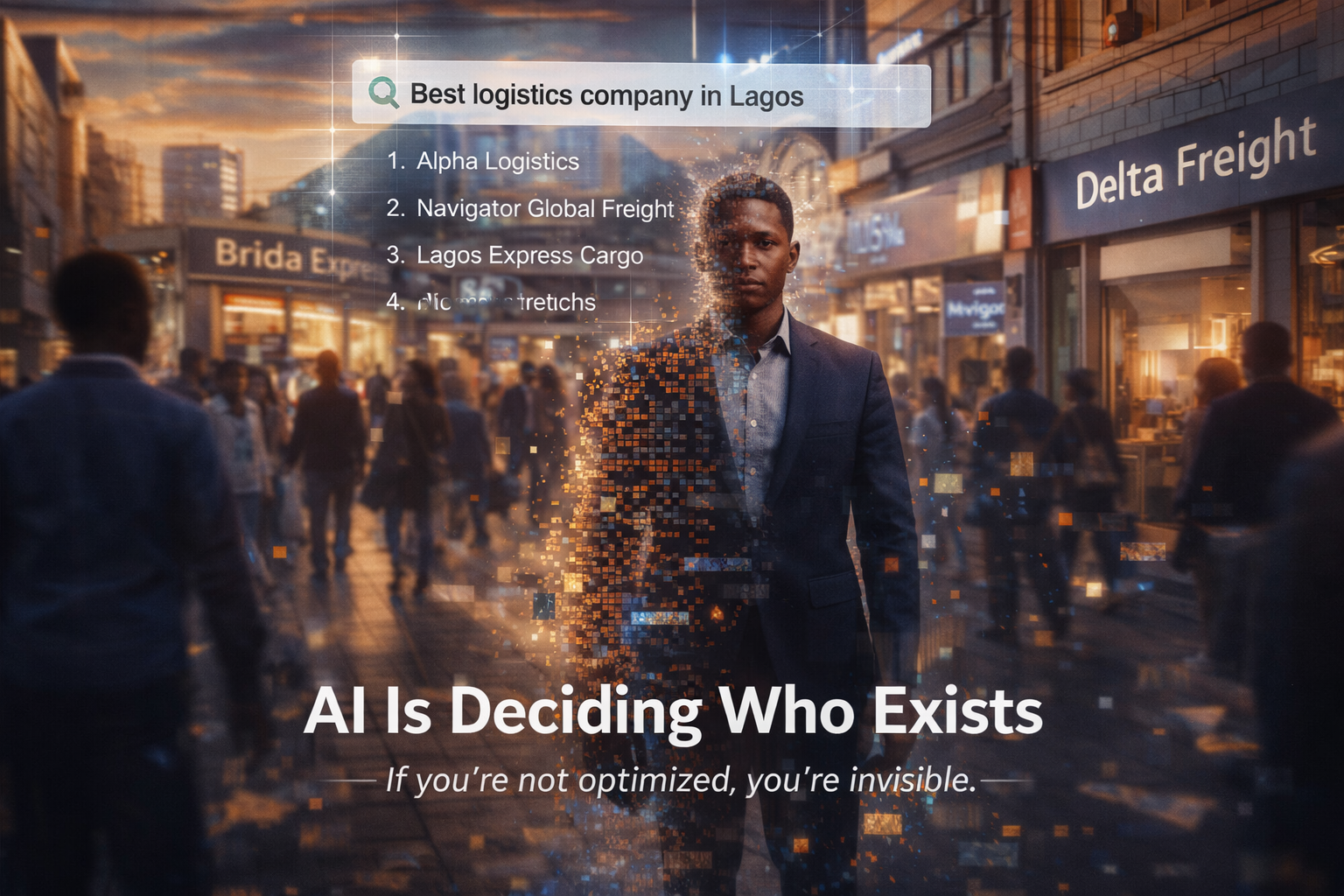
Generative AI traffic is growing 165 times faster than organic search traffic.
As of January 2026, ChatGPT alone is processing 5.4 billion monthly visits, more than double Bing's total. Google AI Overviews now reach 1.5 billion users per month and appear in over 25% of all Google searches. Forrester Research estimates that by the end of 2026, 30% of all web traffic previously driven by organic search will shift to AI-mediated discovery channels.
That is not a trend. That is a structural break in how people find businesses, products, and services online. And for African SMBs that have spent years building their digital presence for Google search, it represents a problem that most have not yet been told about, and that almost none are prepared for.
The problem is called GEO. Generative Engine Optimization. And the businesses that move on it now will own AI-search visibility for years. The ones that wait will spend those same years becoming increasingly invisible.
The Old Game Is Changing
To understand what GEO is, you need to understand what is replacing the traditional search experience.
For the past two decades, online visibility meant ranking in Google's search results. A business optimized its website, built backlinks, produced keyword-rich content, and climbed the rankings. When someone searched for "accountant in Cape Town" or "logistics company Nairobi," your Google ranking determined whether they found you or your competitor.
That model is not dead. But it is being fundamentally disrupted.
When someone today asks ChatGPT, Perplexity, Google Gemini, or Google AI Overviews a question, they do not get a list of ten blue links. They get a synthesized answer generated directly by an AI model. That model cites sources. It references specific businesses, articles, and data points. And then, in most cases, the user never clicks through to a website at all.
This is the zero-click reality. Over 65% of all Google searches now end without a click, according to SparkToro and Datos research. Google AI Overviews, which now appear in 25.11% of all searches (up from 13.14% in March 2025), reduce organic clicks by 58%. When AI Overviews are present, organic click-through rates drop from 1.62% to just 0.61%. Publishers with under 10,000 daily pageviews have lost 60% of their search referral traffic over the past two years. One long-running travel publication, The Planet D, shut down after a 90% traffic drop following the rollout of AI Overviews.
This is happening now. Not in five years. Now.
What Is GEO, Exactly?
Generative Engine Optimization is the discipline of making your business visible inside AI-generated responses.
Traditional SEO asks: can Google find my page and rank it highly?
GEO asks: when an AI model generates an answer about my industry, my services, or my location, does it cite my business as a source? Does it recommend me? Does it know I exist?
These are different questions. And the techniques required to answer them are different.
According to research published in the original GEO paper by Aggarwal et al. from Princeton and Georgia Tech, citing statistics, adding quotations from credible sources, and using fluent, well-structured prose increases a website's visibility in AI-generated responses by up to 40% compared to unoptimized content.
Only 11% of domains that rank on ChatGPT for a given query also rank on Google AI Overviews for the same query. The platforms have different citability criteria. A business optimized for Google is not automatically optimized for AI search, and the gap between the two is widening.
As of January 2026, ChatGPT has 883 million monthly users and commands 60.7% of the AI search market. Perplexity AI has grown 800% year-over-year. Google Gemini holds 15% of AI search market share. Together, these three platforms account for 88.9% of all AI search traffic. Gartner's current projection is sharper than most expected: traditional search engine volume will drop 25% by the end of 2026, not 2028. Forrester estimates 30% of all organic-search-driven web traffic will move to AI-mediated discovery channels within the same timeframe.
Brands that have already invested in GEO are reporting 30 to 40% higher AI-referral traffic compared to competitors relying on traditional SEO alone.
The window to build a position in AI search is open right now. It will not stay open indefinitely.
Why This Matters More in Africa Than Anywhere Else
The global GEO conversation is happening mostly in American and European marketing circles. African businesses are largely absent from it.
This is a serious problem, and here is why.
Africa has 646 million internet users, up from 181 million in 2014. South Africa alone has 50.8 million internet users, representing a 78.9% penetration rate as of January 2025. More than 700 million mobile connections are active across the continent. The African internet economy is projected to reach $200 billion. Over half of surveyed African SMEs across Nigeria, Kenya, South Africa, and Ethiopia are now marketing online.
Some African businesses are online. They have made the investment in digital presence. They have websites, social media accounts, and in many cases, Google Business profiles. What they have not done, because nobody told them to, is optimize for the AI search layer that is now sitting on top of all of that infrastructure.
If a Cape Town accountant appears on page one of Google but does not appear in ChatGPT's response when someone asks "who is the best accountant in Cape Town," that Google ranking is steadily becoming worth less.
There is also a specific vulnerability that African SMBs face: they are more likely to depend on a single digital channel, less likely to have marketing teams tracking emerging platform shifts, and less likely to have the technical infrastructure that GEO optimization requires. The businesses that will feel the impact of AI search displacement first are the ones with the least buffer.
53% of African SMEs currently market online. That is the universe of businesses whose online visibility is being gradually eroded by a shift they are not aware of, have not prepared for, and have not been advised on.
What GEO Optimization Actually Involves
GEO is not a single tactic. It is a discipline with multiple layers, each targeting a different part of how AI models discover, evaluate, and cite content.
Citability and content structure. AI models prefer content that is structured to provide direct, self-contained answers. A passage of 130 to 170 words that answers a specific question completely, cites a credible source, and uses clear factual language is far more likely to be pulled into an AI response than the same information buried in a long narrative paragraph. Fact density matters: data points, statistics, and named sources every 150 to 200 words significantly increase the likelihood of AI citation.
AI crawler access. Fourteen or more specialized AI crawlers index the web for the major AI platforms, including GPTBot (for ChatGPT), ClaudeBot, PerplexityBot, and Google's AI crawlers. Many websites unintentionally block these crawlers through their robots.txt file, which means the AI platforms cannot index their content at all. A business can have excellent content and still be completely invisible to AI search if its crawler settings are wrong.
Brand authority signals. AI models derive authority from how often and where a brand is mentioned across the web. Research into AI citation patterns has found that brand mentions correlate three times more strongly with AI visibility than traditional backlinks. Being mentioned on Reddit, YouTube, LinkedIn, Wikipedia, and industry publications matters far more for GEO than it does for traditional SEO.
Structured data (schema markup). Schema markup is a technical layer added to website code that tells AI systems what a business does, where it operates, who runs it, and what its products and services are. Without it, AI models have to infer this information and often get it wrong or miss it entirely.
Platform-specific optimization. ChatGPT, Perplexity, Google AI Overviews, and Google Gemini do not use the same ranking signals. A business optimized for one platform is not automatically visible on others. Each platform has different content preferences, authority signals, and citation patterns.
E-E-A-T signals (Experience, Expertise, Authoritativeness, Trustworthiness). AI models are trained to prioritize content from sources that demonstrate genuine expertise. This means named authors, verified credentials, specific experience claims, and accurate, citable information are more important than ever.
llms.txt. An emerging standard that allows websites to communicate directly with AI models about how to interpret and cite their content. Similar to how robots.txt communicates with search engine crawlers.
A comprehensive GEO audit evaluates all of these layers, produces a composite score, and identifies the highest-priority improvements for each specific business. The output is a clear, prioritized action plan showing exactly which changes will have the greatest impact on AI-search visibility.
The Window Is Open Now, and It Will Not Stay Open
There is a pattern in how digital visibility shifts work. Those who move early, when the discipline is still developing and the competition for AI-cited positions is low, build durable positions that are expensive to displace later. Those who wait move into a more competitive, more expensive, and more technically demanding environment.
Traditional SEO in 2006 was accessible to any business willing to learn. By 2016, the same outcomes required significantly more investment. By 2024, competing in traditional SEO without a meaningful budget and technical team was extremely difficult in most competitive categories.
GEO in 2026 is where SEO was in 2006. The positions are available. The competition for them is still low, particularly in African markets where almost no businesses are actively optimizing for AI search. The technical barriers are lower than they will be in two or three years. And the advantage that early movers build compounds over time: AI models learn brand authority through repeated citation, which makes early visibility self-reinforcing.
The GEO market itself is forecast to reach $33.7 billion by 2034, growing at a compound annual rate of 50.5%. The businesses that understand this now and act on it are not just preparing for a future trend. They are positioning themselves for a shift that is already underway.
The Questions African Business Owners Need to Ask Right Now
The window to shape your position in AI search is open. The question is whether you use it.
For any business with an online presence:
When someone asks ChatGPT or Perplexity about your type of product or service in your city, does your business appear?
Are your AI crawlers blocked by your robots.txt file?
Is your website structured in a way that AI models can easily extract and cite specific answers?
Are you being mentioned, reviewed, and referenced across the platforms that AI models draw authority from?
Most African SMBs, if they answer these questions honestly, will find significant gaps. Not because they have done anything wrong, but because GEO is a new discipline and nobody has told them it exists yet.
For African business owners thinking about the next three years:
The businesses that will dominate AI-search visibility in 2027 and 2028 are optimizing for it now
AI-powered customer acquisition already reduces acquisition costs by up to 60% for businesses that use it correctly
The transition from traditional SEO to GEO-inclusive digital strategy is not a technology question. It is a business survival question
What Uhuru AI Is Doing About It
At Uhuru AI, we run comprehensive GEO audits for African businesses.
The audit evaluates six weighted categories: AI citability and visibility, brand authority signals, content quality and E-E-A-T, technical foundations, structured data, and platform-specific optimization across ChatGPT, Perplexity, Google AI Overviews, and Gemini. Five parallel subagent analyses run simultaneously, and the outputs synthesize into a composite GEO Score from 0 to 100. Every audit produces a clear, prioritized action plan with specific recommendations for each finding.
We built this because we believe African businesses deserve honest, grounded guidance on where digital visibility is going, not just where it has been.
The shift is happening whether African SMBs are prepared for it or not. Our position is that they should be prepared for it, with clear information, practical tools, and implementation support from an agency that understands both the technology and the African business context.
If you want to know where your business stands on AI-search visibility today, the GEO audit is where that conversation starts.
Sources:
Aggarwal, P. et al. GEO: Generative Engine Optimization. Princeton / Georgia Tech. https://arxiv.org/pdf/2311.09735
Superlines. AI Search Statistics 2026: 60+ Data Points on Visibility, Citations, and Traffic. https://www.superlines.io/articles/ai-search-statistics/
upGrowth. AI Traffic Share Report 2026: ChatGPT, Perplexity and AI Overviews Data. https://upgrowth.in/ai-traffic-share-report-2026/
Presence AI. 2026 GEO Benchmarks Report: AI Search Traffic Statistics and Trends. https://presenceai.app/blog/2026-geo-benchmarks-ai-search-traffic-statistics
Gartner. Traditional Search Engine Volume to Drop 25% by 2026. https://www.gartner.com
Forrester Research. AI-Mediated Discovery Channels Traffic Forecast 2026. https://www.forrester.com
The Digital Bloom. Organic Traffic Crisis Report, 2026 Update. https://thedigitalbloom.com/learn/organic-traffic-crisis-report-2026-update/
SparkToro / Datos. Zero-Click Search Research 2026. https://sparktoro.com
Incremys. 2026 GEO Statistics: Applications, Market and Future Outlook. https://www.incremys.com/en/resources/blog/geo-statistics
Similarweb. Generative Engine Optimization: The Complete 2026 Guide. https://www.similarweb.com/blog/marketing/geo/what-is-geo/
Position.digital. 100+ AI SEO Statistics for 2026. https://www.position.digital/blog/ai-seo-statistics/
DataReportal. Digital 2025: South Africa. https://datareportal.com/reports/digital-2025-south-africa
Klasha. Africa Is the Biggest Online Growth Market in the World. https://www.klasha.com/blog/africa-is-the-biggest-online-growth-market-in-the-world
Africa MSME Survey Report. 2023. https://www.pandoraagency.co
Host Africa. Africa's Digital Economy Is Accelerating. https://hostafrica.co.za/blog/business/africas-digital-economy-accelerating/
Search Engine Land. Generative Engine Optimization: How to Win AI Mentions. https://searchengineland.com/what-is-generative-engine-optimization-geo-444418
Uhuru AI is a South African AI and automation agency. We build intelligent systems for businesses that want to grow. We also believe African businesses deserve honest, grounded analysis about where technology is taking us.
Follow us on LinkedIn, Instagram, Twitter, and Facebook for daily commentary on AI, automation, and the African opportunity.
Tsolo Moahloli
Founder, Uhuru AI
Tsolo Moahloli is the founder of Uhuru AI, a Pretoria-based AI automation firm helping South African SMBs save 20+ hours weekly through practical automation. He specialises in workflow automation, AI assistants, and sales AI systems built for the South African market.
Learn more about Tsolo